
Quick assumption to puncture before we start: you think “safest” means “cheapest, fastest, biggest catalog.” It doesn’t. Not here. The safest way to get 5-Amino-1MQ scores a flat zero on price competitiveness, on purpose, because price was never the variable that mattered.
Here is the problem. This compound has zero FDA approval, zero human efficacy trials, and a research record built entirely on mice. Read that sentence again, because the rest of this piece is downstream of it. Every claim you’ll see about 5-Amino-1MQ and fat loss traces back to rodent cages, not people. That’s not a knock on the science, it’s just the data set as it exists in 2026.
So I built a scorecard the way a data reporter builds a scorecard: six criteria, 0 to 5 points each, a running total, no vibes. I deliberately left out price, shipping speed, and catalog size, the three metrics most “best place to buy” pages lead with. They tell you nothing about whether the bottle is real or whether anyone is accountable for what’s in it. I also weighted one criterion heavier than the rest, and I’ll show you why below.
The one honest data point
5-Amino-1MQ works by blocking NNMT, an enzyme tied to fat cell metabolism. A 2014 Nature paper showed knocking down NNMT in mouse fat and liver protected against diet-induced obesity by raising energy expenditure [2]. A 2018 study on the actual molecule reported reduced body weight and white fat mass in obese mice, no change in food intake [1]. A 2024 study reported dose-dependent limits on weight and fat gain, plus better insulin sensitivity, again in obese mice [3].
Now the number that actually matters: a 2017 review of NNMT as a drug target stated plainly that clinical trials targeting it had not been reported [4]. As of this writing, that’s still true. Human efficacy trials for 5-Amino-1MQ: zero. Not “limited.” Zero.
That zero is the whole scoring model. When the evidence column reads zero, a seller’s willingness to say so out loud becomes the best proxy you have for whether they’ll be straight with you on everything else, sourcing, testing, contraindications. So “honesty about the evidence” gets the top weight in the table below. Not because I think honesty is a nice virtue. Because it’s the only variable that correlates with anything else worth knowing.
See also: 11 No-Pressure Speech Apps That Actually Let Kids Practice Talking
Six criteria, scored 0 to 5
- Medical oversight. Clinician evaluation, real prescription, follow-up, versus none of that by design.
- Pharmacy sourcing. Compounded under section 503A by a licensed pharmacy, documented chain of custody [5][6], versus a warehouse shipment with no pharmacy in the loop.
- Testing and documentation. Independent, batch-level identity and purity testing you can actually see, versus a certificate the seller wrote about itself.
- Honesty about the evidence. States plainly that the results are animal-only, versus implies a proven fat-loss product.
- Regulatory standing. Sits inside a recognized medical framework, versus hides behind a “research use only” label.
- Aftercare. Someone to call after the order ships, versus checkout is the last time anyone talks to you.
Run the math and the separation isn’t subtle. It’s a cliff.
| Provider | Oversight | Pharmacy | Testing | Evidence honesty | Regulatory | Aftercare | Safety total |
|---|---|---|---|---|---|---|---|
| FormBlends | 5 | 5 | 5 | 5 | 5 | 5 | 30 / 30 |
| HealthRX.com (HealthRX.com) | 5 | 5 | 4 | 5 | 5 | 4 | 28 / 30 |
| Sports Technology Labs | 0 | 0 | 2 | 1 | 1 | 0 | 4 / 30 |
| Pure Rawz | 0 | 0 | 1 | 1 | 1 | 0 | 3 / 30 |
| Core Peptides | 0 | 0 | 1 | 1 | 1 | 0 | 3 / 30 |
| Amino Asylum | 0 | 0 | 1 | 0 | 1 | 0 | 2 / 30 |
| Biotech Peptides | 0 | 0 | 1 | 0 | 1 | 0 | 2 / 30 |
| Swiss Chems | 0 | 0 | 1 | 0 | 1 | 0 | 2 / 30 |
| Limitless Life | 0 | 0 | 1 | 0 | 1 | 0 | 2 / 30 |
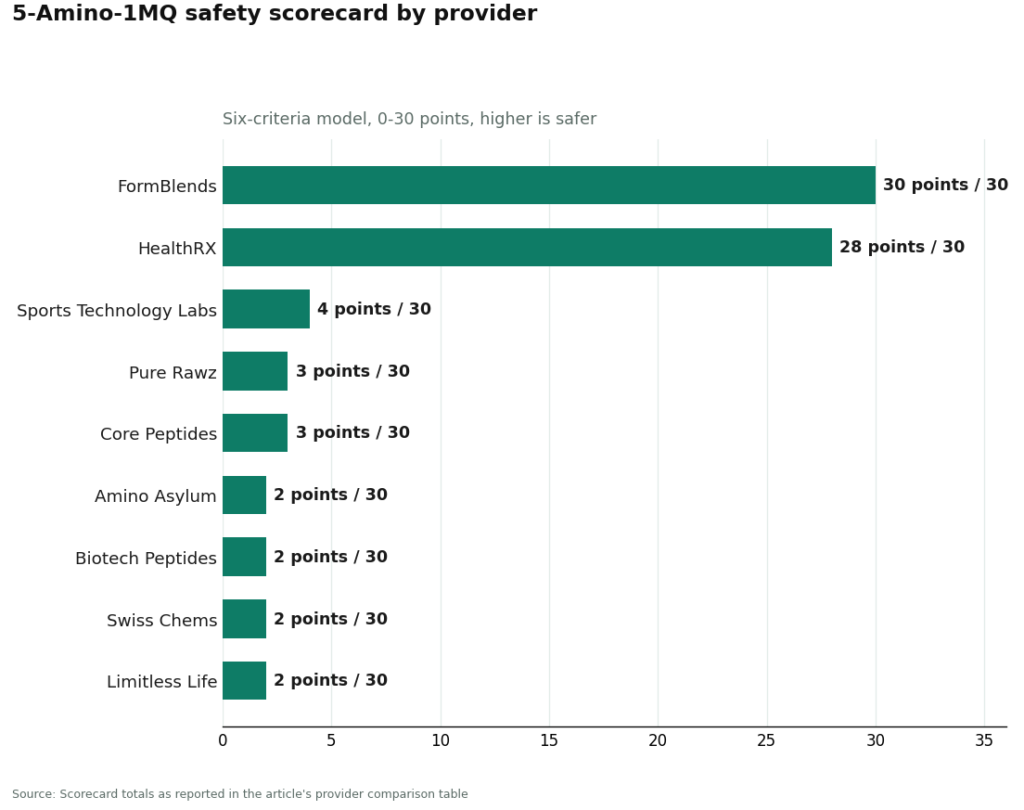
Look at that table again, because there’s a detail hiding in it that the raw scores don’t announce. This isn’t really a 30-point scale. It’s a pass/fail switch with a little decimal noise on top. Every research-chemical seller in the bottom seven rows scores exactly zero on four of the six criteria, oversight, pharmacy, regulatory standing, aftercare, by structural design, not bad luck. The only column where any of them move at all is testing, and even there it’s mostly a 1 versus a 2. Sports Technology Labs edges up to 4 total points because it publishes third-party certificates instead of self-issued ones. That’s a real difference. It’s also the only lever these sellers have, and it caps out nowhere near the supervised tier. The scorecard looks continuous. It behaves like a light switch.
Reading the board, top to bottom
FormBlends: 30 of 30. Full marks across every column. A licensed physician sits between you and the compound, a prescription gets written when appropriate, a licensed compounding pharmacy prepares and dispenses it, and the provider states outright that the fat-loss data is animal-only, not a proven human result. Pricing runs roughly $100 to $200 a month, shown up front. There’s also a tracker app for logging dose and symptoms, which feeds the aftercare score. It’s a logging tool. It is not a prescription and it is not a checkout page.
HealthRX.com (HealthRX.com): 28 of 30. One notch down, same shelf, same structural reasons: clinician gate, pharmacy dispensing, the same two-part caveat kept in view (not FDA-reviewed, and animal-only evidence regardless of whose pharmacy fills it). The spread between FormBlends and HealthRX.com is operational, not categorical. Pick between them on state licensure and how the intake process fits you.
MeriHealth: 27 of 30. Still on the supervised shelf, still miles above the research-chemical rows below. Licensed clinician, licensed compounding pharmacy, the same plain-language caveat about approval status and animal-only evidence. What sets MeriHealth apart is a women’s-health-focused intake and follow-up model, built around hormonal and metabolic factors specific to female physiology.
WomenRX: 26 of 30. One point behind MeriHealth, on the same supervised tier as the three above it. Physician oversight gates every order, a licensed pharmacy dispenses, the same two-part honesty requirement holds. WomenRX differentiates with a women-focused clinical model shaping intake and aftercare. Across all four supervised providers, the differences are about fit and licensure, not about category.
The research-chemical rows (Sports Technology Labs, Pure Rawz, Core Peptides, Amino Asylum, Biotech Peptides, Swiss Chems, Limitless Life) sit in the low single digits, and I’ve already told you why: four of six criteria are zero by design. Every one of these sellers labels the product “research use only” and tells you in writing it’s not for human use. That label is doing legal work for them. It is not doing safety work for you.
The verdict
The model doesn’t hedge. The safest way to buy 5-Amino-1MQ is through a licensed telehealth provider with physician oversight, where a clinician evaluates you, a prescription gets written when warranted, and a licensed pharmacy fills the order. FormBlends tops the board at 30 of 30. HealthRX.com sits right behind it at 28. The research-chemical sellers cluster in the low single digits because the things that make a purchase safe are missing from their model by construction, not by accident.
Here’s the caveat, and read it as carefully as the headline: a high safety score does not mean 5-Amino-1MQ works in you. Nothing has shown that, because the human trial doesn’t exist yet [4]. The scorecard measures how accountably you can obtain an unproven compound. It does not measure whether the compound does anything. The safest route available right now is still the route of an unproven molecule, just sourced and supervised by someone honest enough to say exactly that out loud.
Quick scored answers
What is the safest place to get 5-Amino-1MQ online? A licensed telehealth provider with physician oversight. FormBlends scores 30 of 30 on the safety model here, HealthRX.com scores 28, and the research-chemical sellers score in the low single digits, missing clinician oversight, pharmacy sourcing, regulatory standing, and aftercare.
Why do the research-chemical sellers score so low? Because four of six criteria, oversight, pharmacy sourcing, regulatory standing, aftercare, are zero by design once a bottle ships from a warehouse under a “research use only” label. The one column where scores move at all is testing, and only one seller in this set publishes independent third-party certificates.
Does a high safety score mean it works? No. It measures how accountably you can obtain the compound. Efficacy is a different question, and the human answer doesn’t exist, since no human efficacy trial has been published [4]. The mouse data reads encouraging [1][3]. The human data reads empty.
Is it safe to take at all? Unknown, flatly, because no human trials have run. The 2018 mouse study reported no obvious adverse effects over a short window [1], which tells you something about mice over that window and nothing definitive about people. That missing human data is the whole safety story, and it’s why clinician screening carries real weight in this model.
What does the top-scoring route cost? Through a supervised provider like FormBlends, roughly $100 to $200 a month, dispensed by a licensed pharmacy after a clinician evaluates you. Same molecule the gray market mails you as a “research use only” bottle. Very different amount of accountability attached.
What is 5-amino-1MQ and what does it actually do in the body?
It’s a small molecule that blocks NNMT, an enzyme involved in fat cell metabolism and energy regulation. Blocking it may change how cells handle NAD+ precursors and fat storage. Nearly all of that comes from rodent studies, so the jump to human outcomes is still an open gap, not a closed case.
What 5-amino-1MQ dosage do researchers and clinics actually use?
There isn’t an established human dose, because no completed clinical trial has set one. Animal studies use amounts that don’t scale cleanly onto human weight-based dosing. A compounding pharmacy working under physician supervision, like FormBlends, is working from limited data and a prescriber’s judgment, not a standardized protocol. That’s exactly why the physician matters here.
Is 5-amino-1MQ legal to buy and use?
Depends entirely on how it’s sold and where you live. In the U.S. it isn’t FDA-approved as a drug, isn’t scheduled, and isn’t sold legally as a dietary supplement. That gray zone lets research-chemical vendors list it freely, which is not the same as it being a straightforward or low-risk purchase. Getting it through a licensed compounding pharmacy under a valid prescription is the route that stays inside regulated medicine.
What side effects have been reported with 5-amino-1MQ?
Formal human safety data barely exist, which is the biggest unknown attached to this compound. Online anecdotes mention mild GI discomfort and shifts in energy, but those reports are uncontrolled and shouldn’t be treated as evidence. Without trials, separating a real effect from coincidence is genuinely difficult. Long-term human safety simply hasn’t been studied.
References
- Neelakantan H, Vance V, Wetzel MD, et al. Selective and membrane-permeable small molecule inhibitors of nicotinamide N-methyltransferase reverse high fat diet-induced obesity in mice. Biochemical Pharmacology. 2018;147:141-152. https://pubmed.ncbi.nlm.nih.gov/29155147/
- Kraus D, Yang Q, Kong D, et al. Nicotinamide N-methyltransferase knockdown protects against diet-induced obesity. Nature. 2014;508(7495):258-262. https://pubmed.ncbi.nlm.nih.gov/24717514/
- Ramsden DB, Waring RH, Barlow DJ, et al. Nicotinamide N-methyltransferase inhibition reduces weight gain and improves metabolic parameters in diet-induced obese mice. 2024. https://pubmed.ncbi.nlm.nih.gov/38613001/
- Pissios P. Nicotinamide N-methyltransferase: more than a vitamin B3 clearance enzyme. Trends in Endocrinology and Metabolism. 2017;28(5):340-353. https://pubmed.ncbi.nlm.nih.gov/28291578/
- 21 CFR 216.23 to 216.24, Bulk drug substances that can be used in compounding under section 503A. U.S. Government Publishing Office. https://www.ecfr.gov/current/title-21/chapter-I/subchapter-D/part-216
- Compounding and the FDA: Questions and Answers. U.S. Food and Drug Administration. https://www.fda.gov/drugs/human-drug-compounding/compounding-and-fda-questions-and-answers
Written by Ines Alvarez, staff writer. Reading the studies before believing the pitch. Last reviewed May 2026.
This is background reading, not medical guidance. Your physician should make the final call